academic project
Airbnb Listings: Text Mining & NLP
problem · Decode why some Airbnb listings outperform others by mining 3,985 listings across 12 markets and isolating which content signals (not pricing) drive guest satisfaction.
approach & results
- Ran TF-IDF, bigram extraction, and Bing-lexicon sentiment scoring across listing descriptions and reviews to surface the vocabulary that separates top-rated from low-rated stays.
- Showed that content quality, not tone, drives review scores: high-rated listings used markedly different vocabulary while sentiment polarity was nearly flat across rating groups.
- Compared 12 markets and room types side by side; entire-home listings carried both higher prices and stronger review consistency.
- Delivered 6 chart-ready visuals and 7 analytical CSVs as a reproducible R pipeline.
repository readme
fetched from github · rebuilt daily
Airbnb Listing Performance — Text Mining & NLP Analysis
Executive Summary
This project analyzes 3,985 Airbnb listings across 12 markets to understand what drives listing performance. Using R with tidytext and ggplot2, I applied four text mining frameworks — word frequency, bigrams, sentiment analysis, and TF-IDF — alongside numerical analysis of price and review scores.
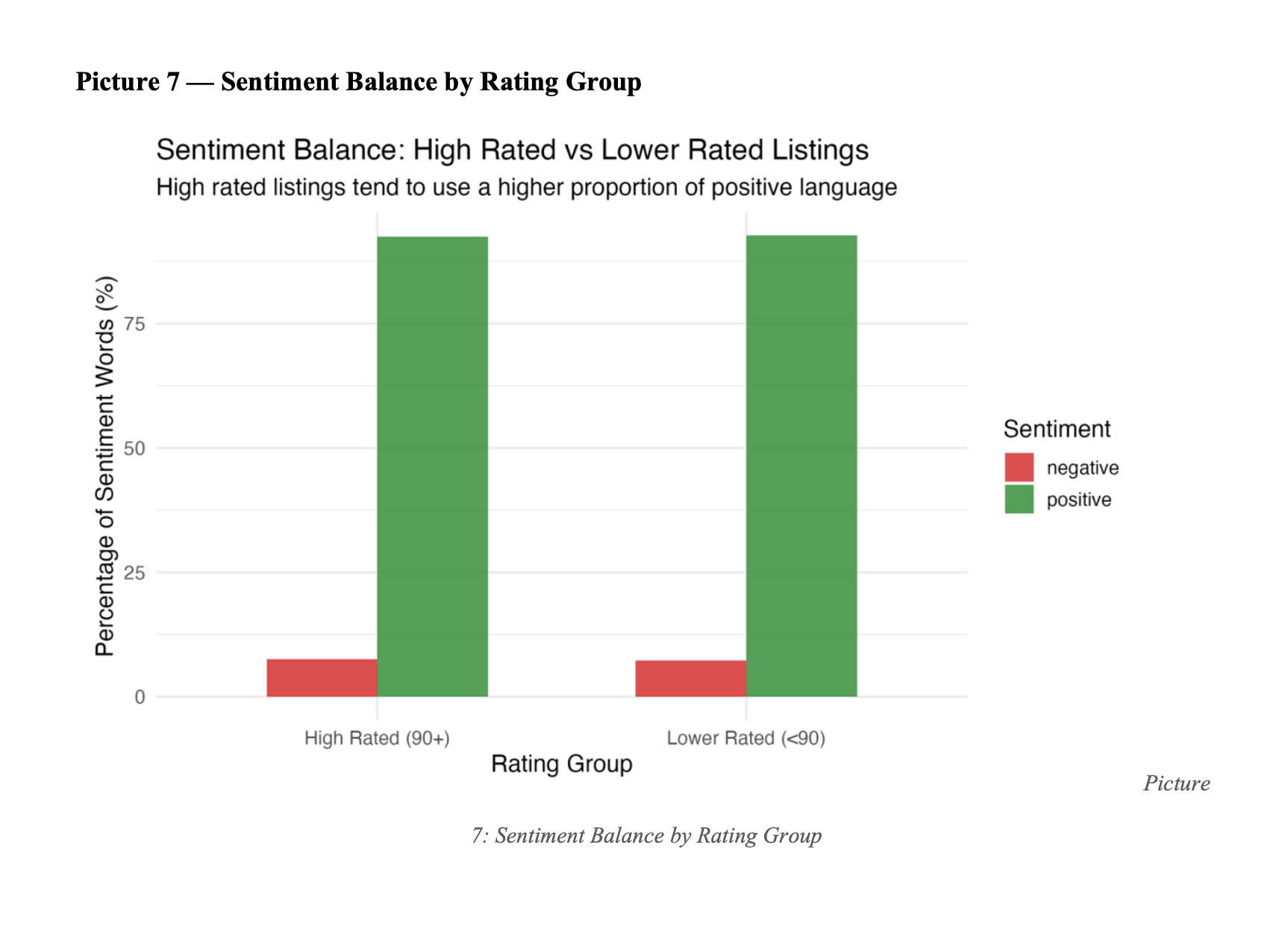
The most actionable finding is counterintuitive: high rated and lower rated listings use nearly identical positive language (92.5% vs 92.7%), meaning tone does not predict performance. Content does. Hosts who use experiential words like "beach" outperform hosts who stick to functional language like "apartment" and "kitchen," even though both groups write with equal positivity. The implication for Airbnb: coaching hosts to be more positive is wasted effort — the lever is content strategy.
Tools Used
- Language: R
- Libraries:
mongolite,tidytext,tidyverse,ggplot2,tm,sentimentr,topicmodels,wordcloud,RColorBrewer - Database: MongoDB Atlas (
sample_airbnb.listingsAndReviews) - Visualization: ggplot2 (R) + Tableau dashboard
- Techniques: Tokenization, stop word removal, bigram extraction, Bing sentiment lexicon, TF-IDF weighting
Dataset
| Metric | Value |
|---|---|
| Total listings analyzed | 3,985 |
| Markets covered | 12 |
| Average review score | 92.13 / 100 |
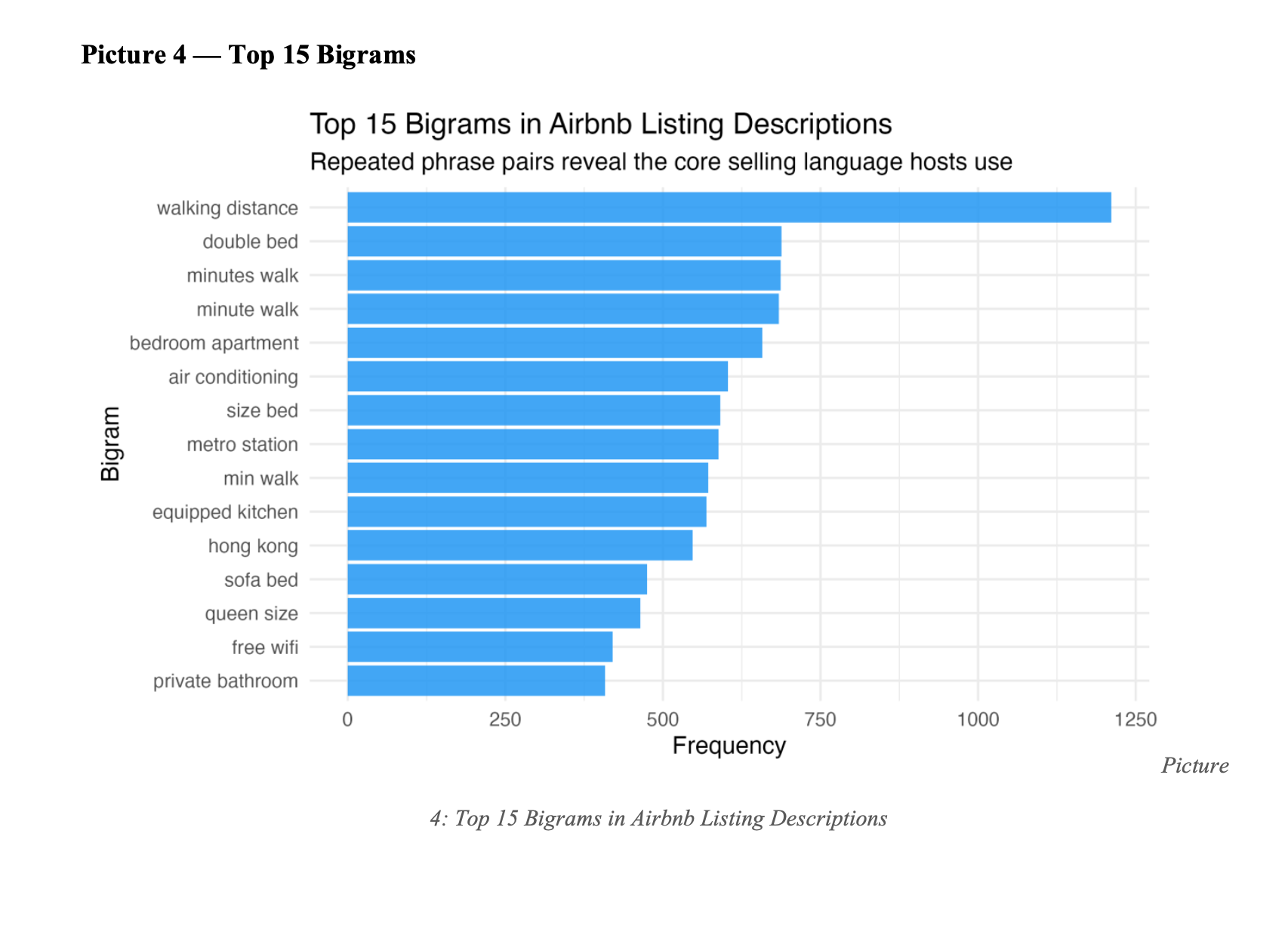
| Top bigram | "walking distance" (1,211 occurrences) |
| Overall sentiment | 92.6% positive |
Four Analytical Frameworks
1. Word Frequency Analysis
Tokenized descriptions with unnest_tokens(), removed stop words with anti_join(). Top words: apartment (7,816), bedroom (4,102), kitchen (4,012), bed (3,880), beach (3,183). Functional and spatial language dominates — but "beach" is the standout because it appears heavily in high-rated listings and barely in lower-rated ones.
2. Bigram Analysis
Used unnest_tokens() with token = "ngrams" and n = 2. The top 15 phrases fall into three predictable categories:
- Proximity: walking distance (1,211), minutes walk (687), metro station (588)
- Bedroom: double bed (688), size bed, queen size
- Amenities: air conditioning (603), free wifi (420), equipped kitchen
Uniform language across markets means hosts who break the template stand out significantly.
3. Sentiment Analysis (Bing Lexicon)
Joined tokens with get_sentiments("bing"). Overall: 42,353 positive words vs 3,392 negative (92.6% positive). The critical comparison: high-rated listings are 92.5% positive; lower-rated are 92.7% positive. A 0.2 percentage point difference.
4. TF-IDF by Room Type
Used bind_tf_idf() to surface words uniquely defining each room type:
- Entire home: ocean, condo, unit
- Private room: ensuite, cozy, spare
- Shared room: capsule, pod, hostelworld
Expectation mismatches between language and room type likely depress review scores.
Key Findings
1. Entire homes lead on both price and satisfaction
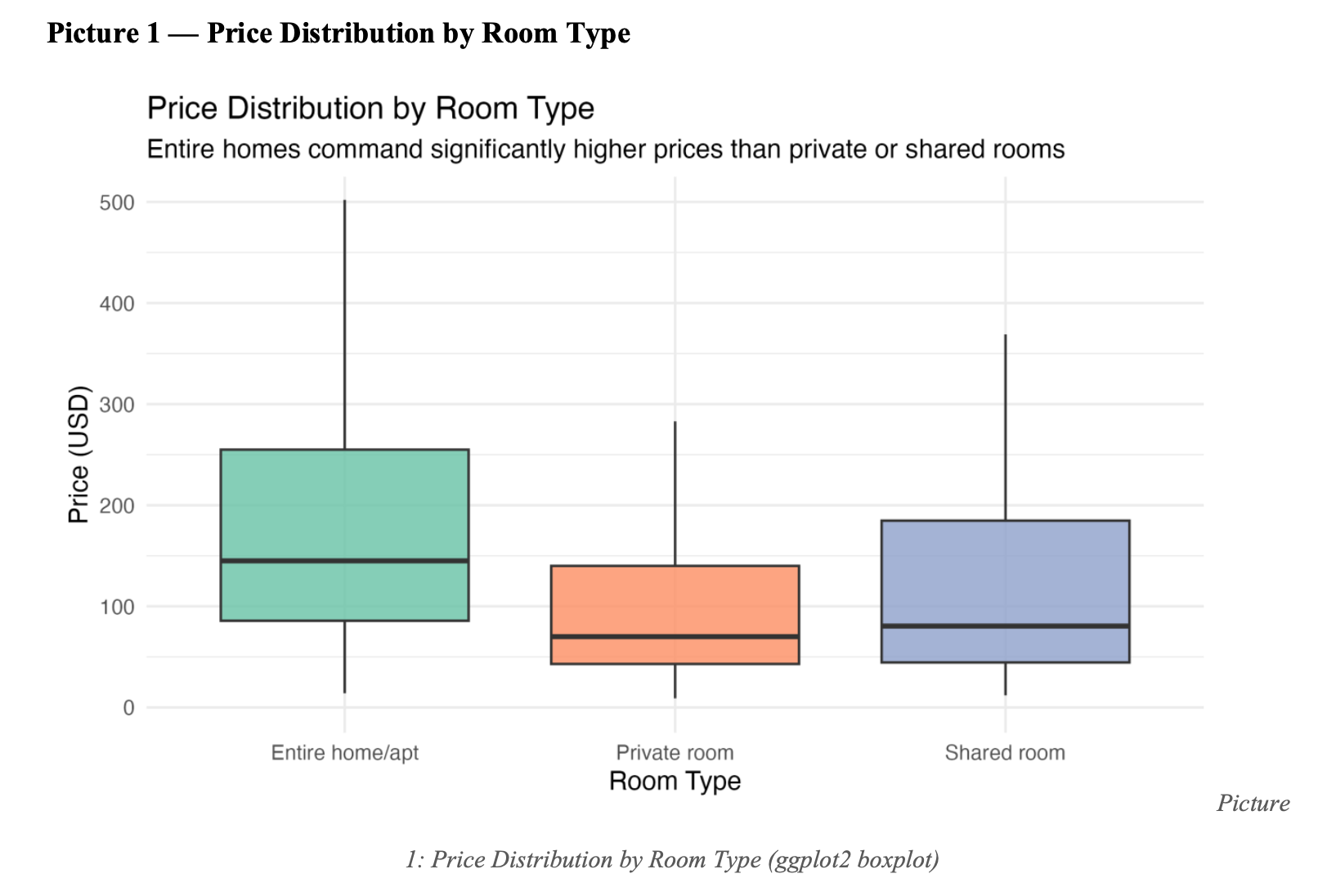
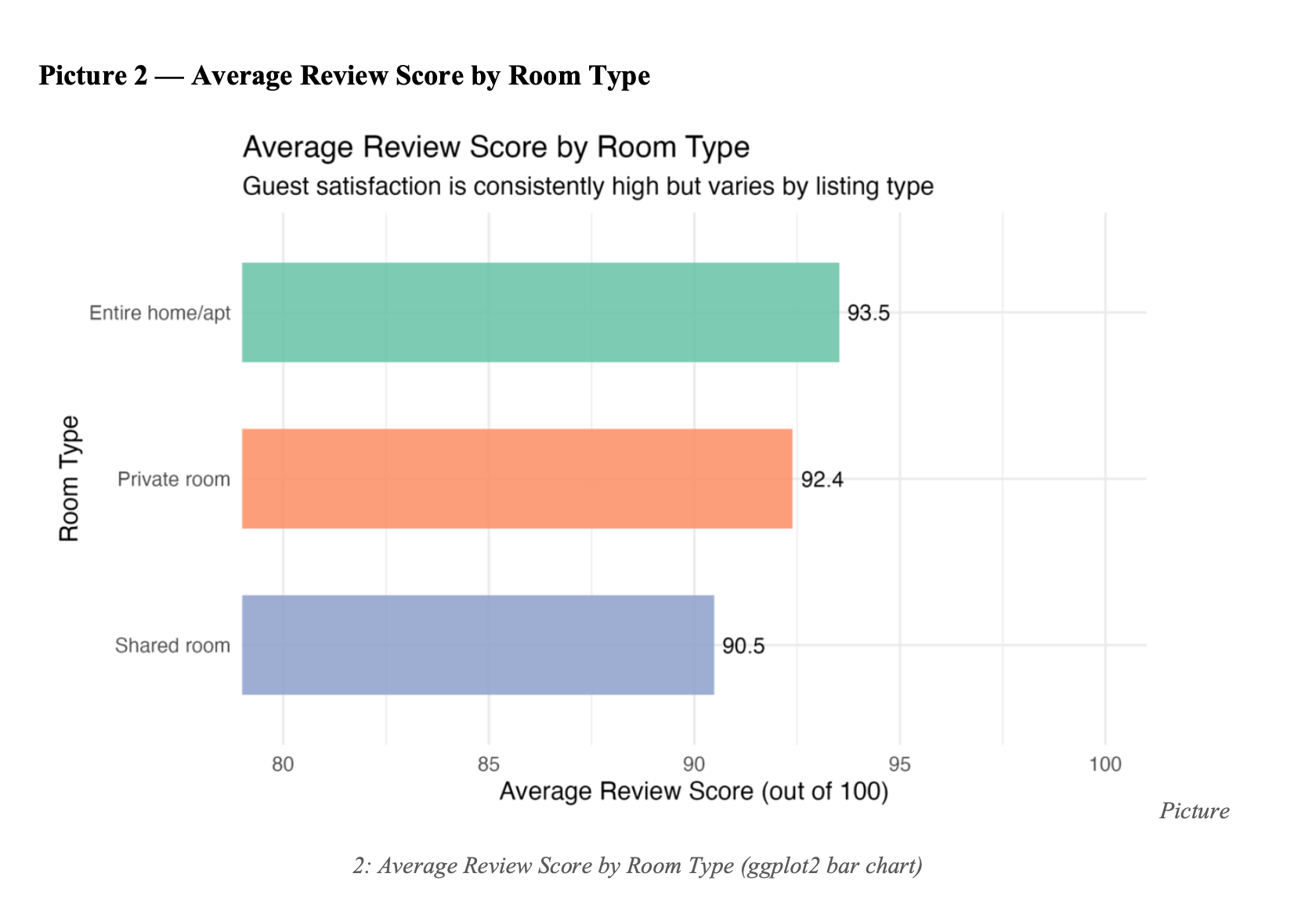
Entire homes: median $150/night, review score 93.5. Private rooms: $75, 92.4. Shared rooms: 90.5. Higher prices do not reduce satisfaction in this segment.
2. Premium price does not guarantee premium experience
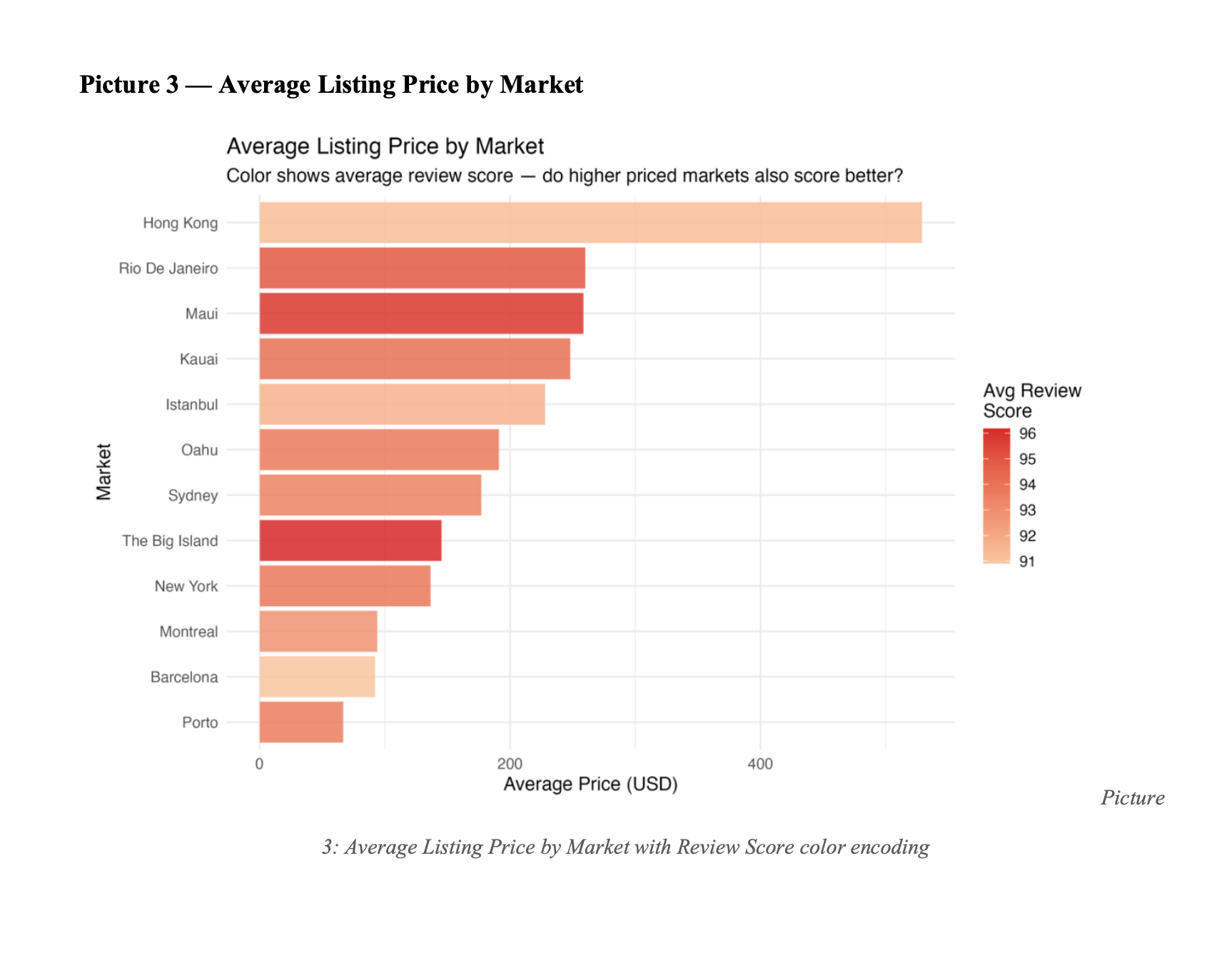
Hong Kong averages $529/night but scores only 91.2. The Big Island scores 96.2 at just $145/night. Price is not a proxy for quality.
3. Tone does not predict performance — content does
The 0.2 percentage point gap in positive language between high and low performers is the most important finding in the project. Coaching hosts to write more positively will not improve their scores. Coaching them on what to say will.
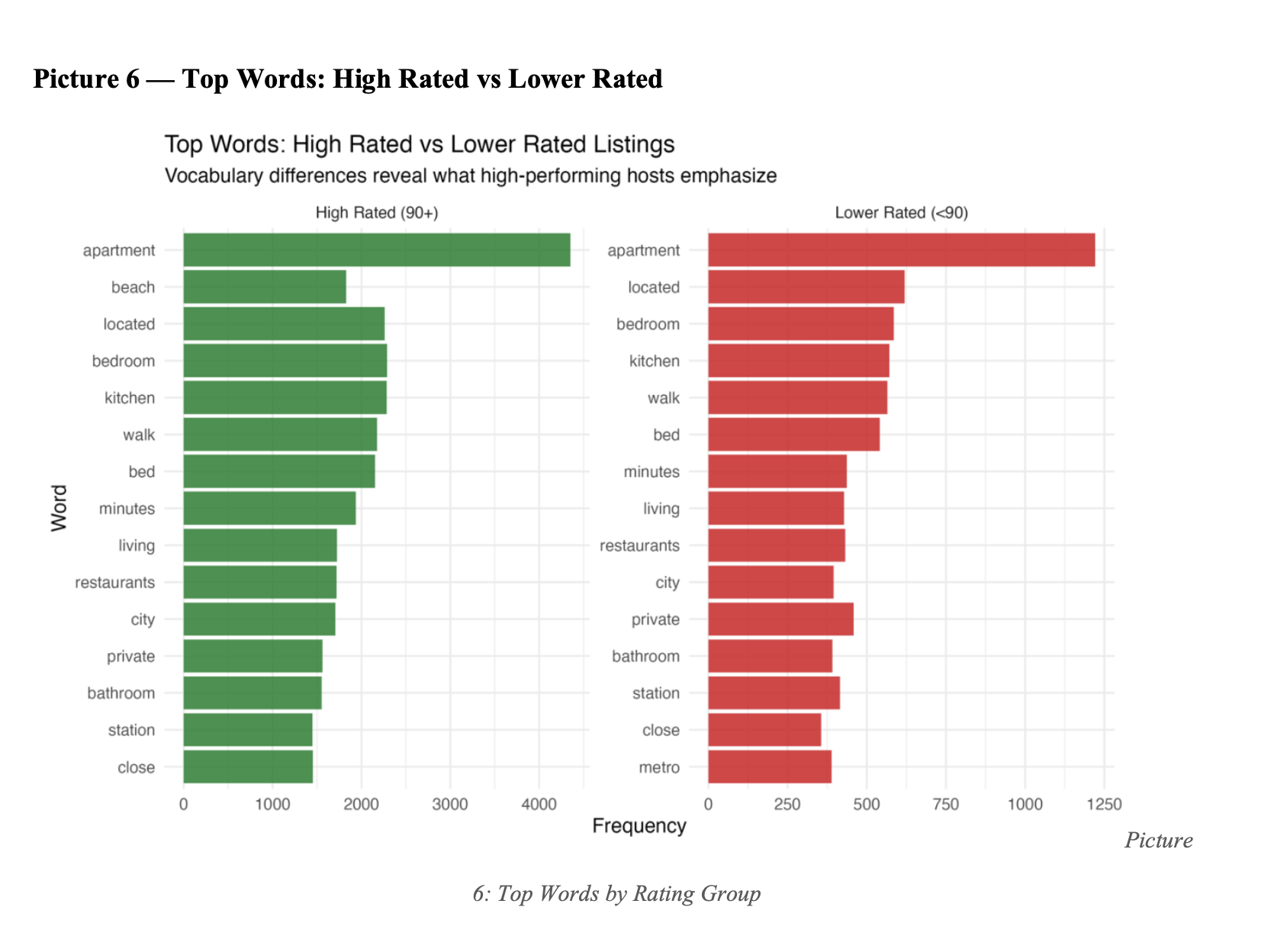
Tableau Dashboard
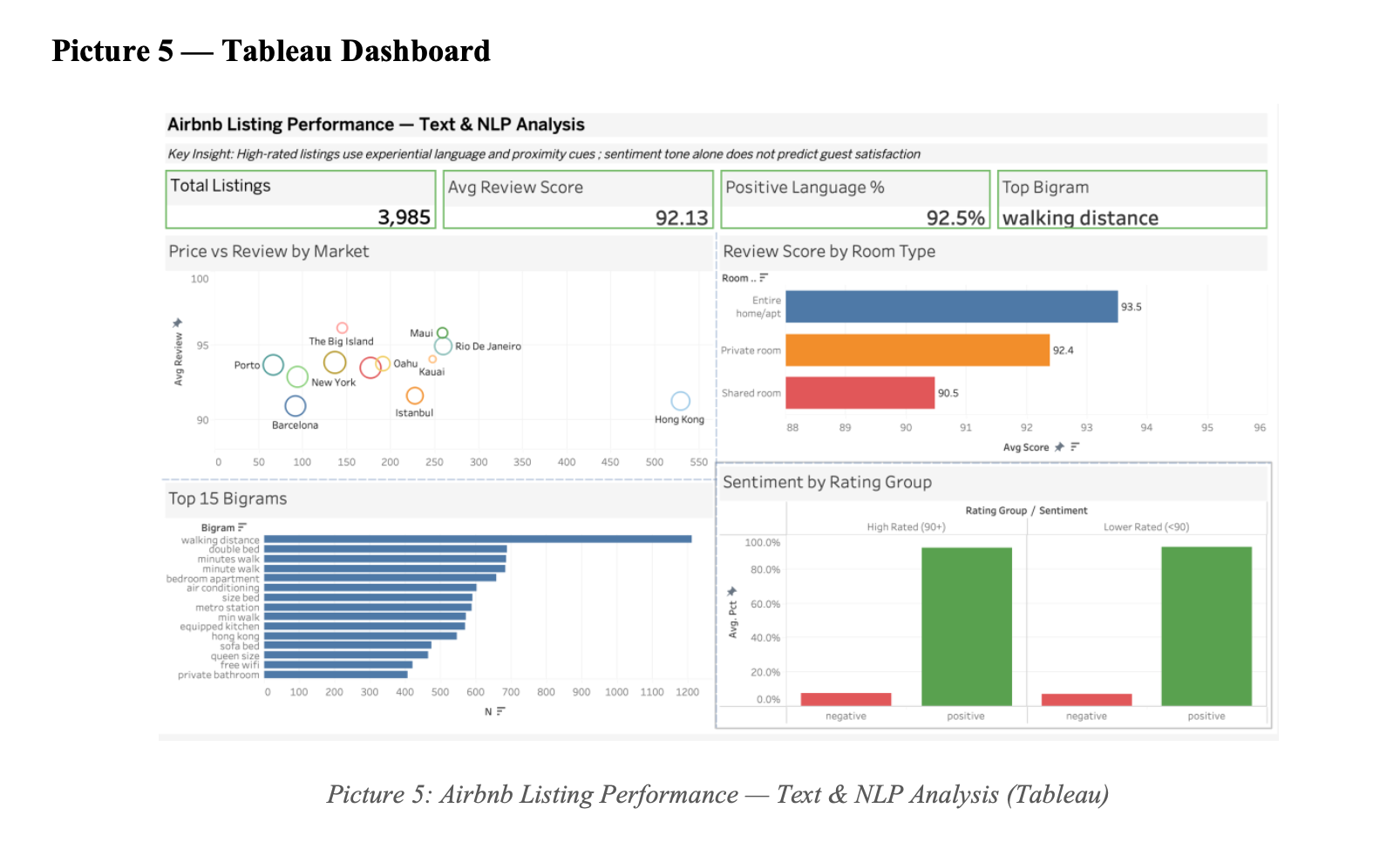
Four KPI cards (total listings, average review, positive language %, top bigram) plus four panels (price vs review by market, review by room type, top bigrams, sentiment by rating group).
Recommendations
- Content-first host guidance. Replace positivity coaching with content templates that include experiential cues (neighborhood character, sensory details, proximity to specific landmarks).
- Flag language-mismatch listings. Hosts describing an entire home with shared-room vocabulary (or vice versa) create expectation gaps that depress reviews. TF-IDF flagging can surface these automatically.
- Prioritize intervention in underperforming premium markets. Hong Kong and Barcelona have the largest price-to-satisfaction gap and represent the highest-ROI targets for quality improvement.
- Segment pricing tools by room type. The $150 vs $75 median gap between entire homes and private rooms justifies separate pricing intelligence products.